Data Breach Response: What the First 24 Hours Actually Look Like
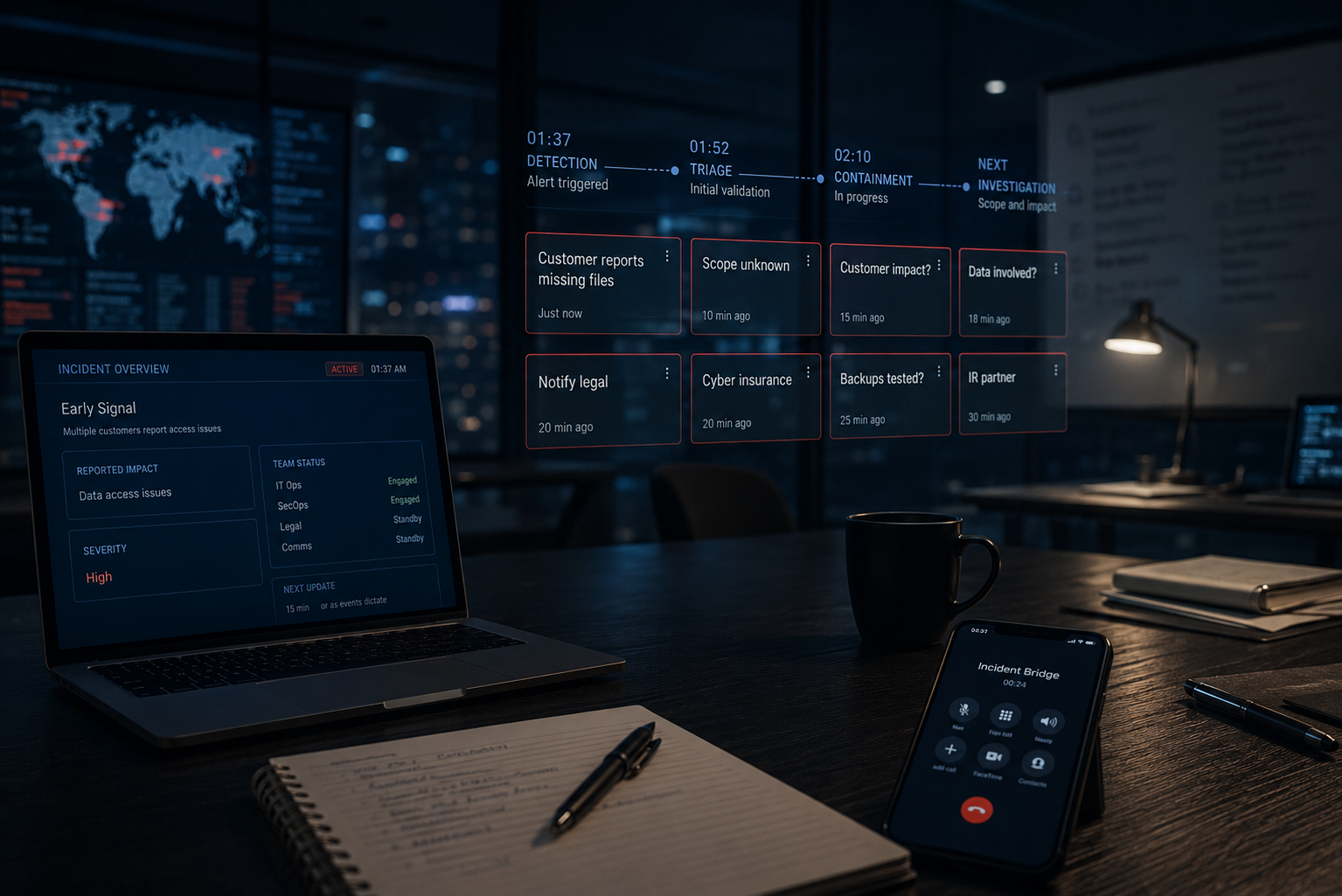
A few years ago, I was pulled into an incident that started with a single customer call. The customer had logged into the platform that morning and noticed files were missing.
At first, everyone assumed it was a support issue.
Then a second customer reported something similar.
Then a third.
Within an hour, leadership was pulled into the conversation.
At that point, nobody knew whether the issue was operational, accidental, or security related.
The investigation was just getting started.
The questions started immediately:
Are customers impacted?
Do we know what happened?
Can we see what's going on?
What data is involved?
How many customers could be affected?
Do we need to notify anyone?
The security team was trying to determine the scope of the issue. Leadership was trying to understand what it meant for the business.
Neither side had enough information yet.
That's one of the hardest realities of a data breach. The questions start long before the answers do.
Most people wondering what to do when you get hacked imagine forensic investigators tracking attackers through logs and systems. In reality, the first few hours are usually spent trying to understand impact quickly enough for the business to make decisions.
Breach response
What happens in the first 24 hours
Hour 1
Detection & triage
Confirm it's a security event
Scope initial impact
Assemble the right people
Notify cyber insurer
Hour 4
Containment decisions
Isolate or keep running?
Engage IR partner
Preserve evidence
Loop in outside counsel
Hour 12
Business continuity
Can backups restore ops?
Customer notification?
Regulatory obligations?
Leadership communications
Hour 24
Path to recovery
Forensic investigation scope
Public comms decision
Recovery timeline set
Begin lessons-learned log
The First 24 Hours Reveal the Last 12 Months
After being involved in enough incidents, I've noticed something that doesn't get discussed often enough.
The first 24 hours of a breach are rarely defined by the attacker.
They're defined by the decisions the company made long before the breach occurred:
Did they purchase cyber insurance?
Do they have an incident response partner on retainer?
Have they conducted tabletop exercises?
Do they know who is responsible for communications?
Have they tested backups?
Do they understand the role their MSP, MSSP, legal counsel, and leadership team play during an incident?
The organizations that recover fastest are usually not making brilliant decisions under pressure.
They're executing decisions they already made months or years earlier.
Incident Response Speed Comes Down to One Thing: Preparation
One of the biggest differences I see between organizations is how quickly they can assemble the right people.
In mature organizations, the response begins almost immediately.
Cyber insurance is notified. Outside counsel joins the call. The incident response provider is engaged. Internal stakeholders know their responsibilities. The MSP or MSSP understands its role. Everyone starts moving in the same direction.
In less prepared organizations, valuable time is spent figuring out basic logistics.
Who owns the response? Who should be contacted? Who is responsible for customer communication? Does insurance require specific vendors?
Those questions can consume hours during a time when every minute matters.
According to Unit 42's 2026 incident response findings, attackers moved from initial access to data exfiltration in an average of just 72 minutes. Most organizations cannot afford to spend that time determining who should be on the bridge call.
This is true regardless of company size. Whether you run a 20-person professional services firm or a 500-person manufacturer, having a documented incident response plan - and knowing the data breach first steps your team will take - is what separates a contained event from a compounding one. For small businesses in particular, a lightweight incident response plan is not a luxury.
It is the difference between a recoverable incident and one that takes months to clean up.
The difference preparation makes
The first two hours: prepared vs. unprepared
⚠ Without a plan
✕
Scrambling to find who owns the response
No pre-assigned roles = 30–60 min lost
✕
Debating whether to call insurance first or legal first
Wrong order can void coverage
✕
Discovering backups haven't been tested
Unusable recovery = weeks of downtime
✕
MSP and internal IT pointing fingers at each other
No clarity on who does what
✓ With a plan
✓
Incident commander identified before anything starts
Everyone knows their role immediately
✓
Insurer, legal, and IR partner called in the right order
Decision made months before the breach
✓
Backup restoration tested quarterly — timeline is known
Recovery starts in hours, not days
✓
MSP role defined in the IR plan
Everyone moves in the same direction
The Breach Tests More Than Technology
One misconception I often hear is that incident response is primarily a technical exercise. It's not.
A breach quickly becomes a business event. Leadership needs answers. Customers may need communication. Legal obligations must be evaluated. Operational decisions need to be made. Technology teams are investigating the attacker while the business is trying to understand the impact.
This is where preparation becomes visible.
Organizations that have conducted tabletop exercises have already practiced these conversations. The scenario may not be identical, but the process of making decisions under pressure is familiar. The goal of a tabletop isn't to predict every breach. It's to ensure people know what to do when uncertainty arrives.
The Backup Question Always Comes Up
At some point during nearly every serious incident, someone asks the same question.
"Can we restore from backup?"
The answer is often less clear than people expect. Many organizations have backups.
Far fewer have tested them.
Can critical systems actually be restored?
How long will recovery take?
What gets restored first?
Are backups isolated from the attack?
Has anyone practiced the process recently?
A breach has a way of exposing the difference between having a control and knowing it works. The same applies to endpoint protection, logging, asset inventories, privileged access reviews, and countless other security controls.
During an incident, assumptions are replaced by evidence.
Quick check
Is your incident response plan actually ready to execute?
Most organizations think they have a plan. Very few have tested whether it actually works under pressure. Here's what a real plan accounts for:
The organizations that handle incidents best rarely have perfect security.
They have clarity.
They know who owns the response.
They know where their critical data lives.
They understand which systems matter most.
They have relationships with the partners they need.
They have tested the processes they expect people to follow.
Most importantly, they don't spend the first day creating a plan.
They're executing one.
The Question To Ask This Week
If your organization discovered a breach tomorrow morning, would the first few hours be spent responding to the incident or figuring out how to respond?
Because after enough incidents, I've become convinced of one thing.
Most organizations don't discover whether they're prepared during a breach.
They discover whether they prepared before it.
Frequently Asked Questions
Common questions about data breach response, incident readiness, and recovery.
What are the first steps after a data breach?
The first steps are to determine scope, contain active threats, engage the appropriate response teams, preserve evidence, and understand potential business impact. Organizations with a documented incident response plan typically move much faster through this process — the decisions are already made, and the team is executing rather than improvising.
What should a small business do when it gets hacked?
Small businesses should activate their incident response plan, engage internal and external response resources, assess affected systems, preserve evidence, and review notification requirements. Knowing who to call before an incident occurs — your cyber insurer, outside counsel, and IR partner — can significantly reduce recovery time and protect coverage.
How important are backups during a ransomware attack?
Backups are often critical to recovery, but only if they have been tested and can be restored successfully. Having backups and knowing they work are two very different things. Many organizations discover during an incident that their backups are incomplete, out of date, or not isolated from the affected environment. Quarterly restoration tests are the only way to know for certain.
Do tabletop exercises really help with incident response?
Yes. Tabletop exercises help leadership and technical teams practice decision making, communication, and coordination before a real incident occurs. They often expose gaps that would otherwise be discovered during a breach — gaps in roles, notification chains, backup readiness, and third-party coordination. The goal isn't to predict every breach scenario. It's to ensure people know what to do when uncertainty arrives.
What separates companies that recover quickly from those that struggle?
In most cases, preparation. Clear roles, tested backups, a documented incident response plan, third-party coordination, and practiced decision making typically have a greater impact on recovery speed than any individual security tool. The companies that recover fastest are rarely the ones with the most sophisticated technology — they're the ones that didn't spend the first day creating a plan.
Up Next in the Breach Series
This is Post 2 of 3 in TechCompass’s Breach Series. In the next post, we cover what happens after the dust settles — the hard lessons, the security gaps that get exposed, and how organizations rebuild smarter. If you missed Post 1, it covers the warning signs that are almost always present before a breach occurs.
Every organization worries about a breach. Almost none understand what one actually looks like until they live through it. This is the first post in a series on what actually happens before, during, and after a breach. This one is about what comes before: the conditions that were already there, long before anyone knew there was a problem.Every organization worries about a breach. Almost none understand what one actually looks like until they live through it.
A few years ago, I was pulled into an incident that started with a single customer call. The customer had logged into the platform that morning and noticed files were missing. At first, everyone assumed it was a support issue. Then a second customer reported something similar. Then a third. Within an hour, leadership was pulled into the conversation. At that point, nobody knew whether the issue was operational, accidental, or security related. The investigation was just getting started.
The breach is over.The systems are back online. Business is operating again. The incident response team has wrapped up. The cyber insurance claim is underway. Everyone wants to move on.That's exactly when I tell clients to slow down.After being involved in enough incident response engagements, I've learned that the recovery phase is where organizations either become significantly stronger or quietly set themselves up for the next incident.The attack is over, but the work isn't.
What topic do you want to hear about? Let us know.
Is your organization prepared to handle cyber threats? From ransomware readiness assessments to virtual CISO leadership, TechCompass offers comprehensive solutions to secure your digital assets.
.webp)