Your Vendors Are in Your Business. Do You Know Which Ones?
Most companies can name the vendors they depend on. Far fewer can confidently say which ones have access to their most sensitive data right now.
Third-party breaches are no longer rare or distant events. According to the 2026 Verizon Data Breach Investigations Report - third-party involvement in confirmed breaches has now reached 48% of all breaches , a 60% increase from the prior year, and nearly double the year before that. The report analyzed more than 22,000 confirmed breaches across 145 countries, making it the largest dataset Verizon has ever examined in a single report.
For many small and mid-sized businesses, those numbers create an uncomfortable question: Could the same thing happen to us?
Ask most business leaders what their biggest security risk is, and they’ll name a vendor.
Ask them which vendors have access to their most sensitive data right now - and most can’t answer.
That’s the real problem.
In many cases, the answer has less to do with whether a company has “good security” and more to do with whether leadership truly understands the growing network of vendors, platforms, integrations, and third parties operating inside the business.
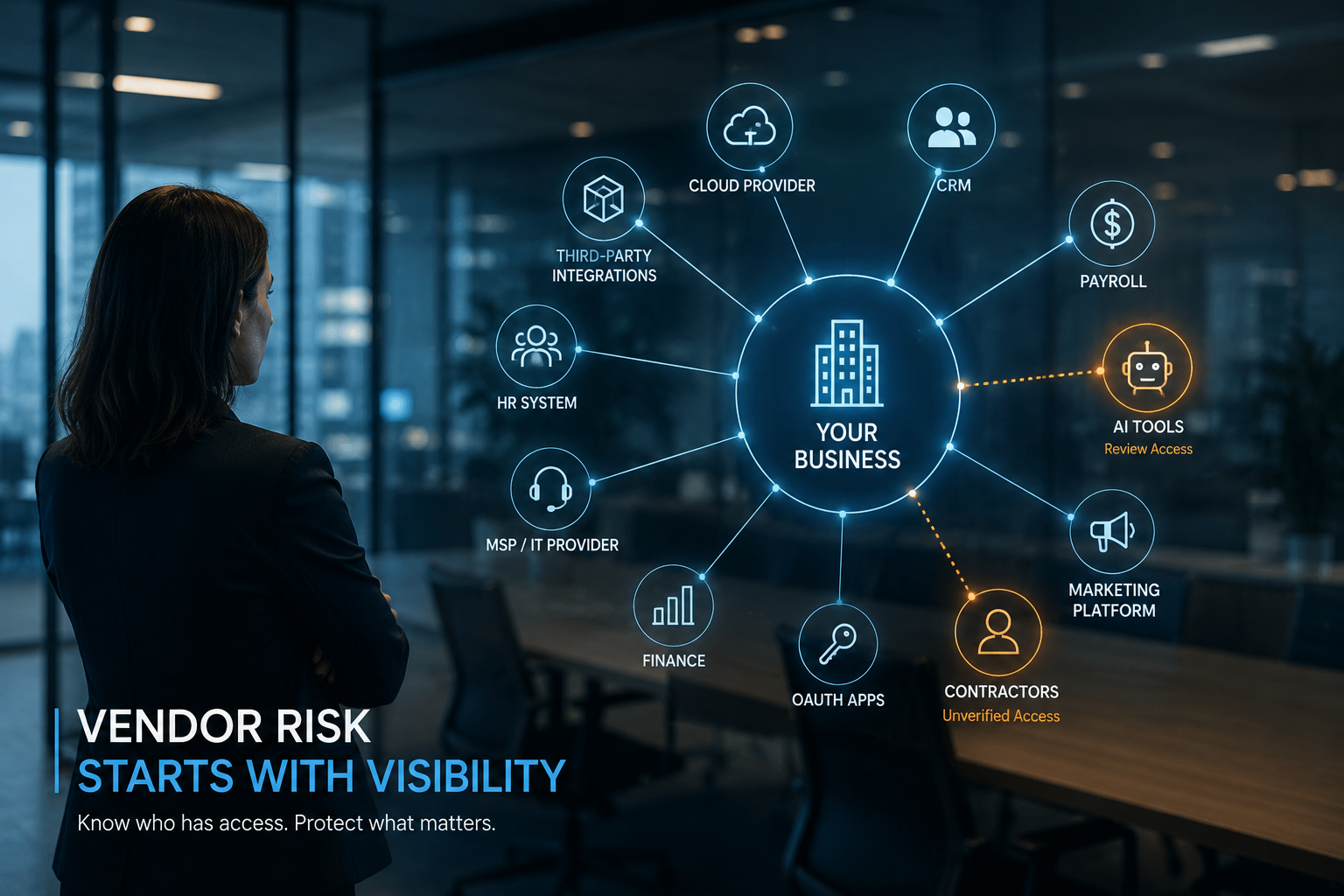
The majority of companies no longer operate entirely inside systems they own or directly control. Business operations now depend on SaaS platforms, MSPs, cloud providers, contractors, outsourced IT teams, payroll systems, AI tools, marketing platforms, and dozens of connected applications working together behind the scenes.
The attack surface has changed significantly over the last five years, especially for fast-growing companies that depend heavily on third-party technology to operate. And in a lot of environments, visibility has not kept pace.
How Fast-Growing Companies Quietly Lose Track of Who Has Access
A typical 20 to 200 person company today may rely on dozens of external platforms to operate day to day - HR systems, accounting software, CRM integrations, cloud infrastructure, managed service providers, OAuth-connected applications, and development contractors.
None of these are bad decisions. Most were made to help the business move faster.
The challenge is that operational growth happens incrementally. A new platform gets added. A vendor receives access to solve a problem. A contractor connects into production systems temporarily. Another department adopts a new SaaS tool without much oversight.
Over time, the environment becomes harder to understand.
Before long, many organizations can no longer confidently answer a simple question:
“What systems, vendors, and people have access to our most important data?”
That is where third-party risk management becomes difficult. The problem is usually not one catastrophic vendor decision. It is years of small operational decisions accumulating quietly in the background.
It’s Not That You Trusted the Wrong Vendor
One of the biggest misconceptions around vendor risk is the assumption that companies experiencing exposure simply failed to care about security. That is rarely what we see in practice.
Most organizations are moving quickly. Teams are solving business problems. Vendors are onboarded to improve efficiency. Integrations are enabled to reduce manual work. Meanwhile, the environment becomes more interconnected every year.
We routinely encounter situations where:
- Former vendors still maintain active access to business systems
- Shared administrator accounts are still in use across teams
- Old integrations remain connected long after they stopped serving a purpose
- Vendors with privileged access were never formally reviewed
- Teams purchased software without security involvement
- Sensitive business data is flowing through systems leadership may not realize are connected
None of this typically happens because a company intentionally ignored cybersecurity. Most organizations simply grew faster than their operational visibility. That is why third-party breaches often feel so disruptive. The issue is not always that a company trusted the wrong vendor. In many cases, the organization never fully mapped how dependent the business had become on external systems over time.
Your attack surface no longer stops at your internal network or cloud environment. It now includes every company you do not directly control.
Vendor risk assessment
Most companies we work with can't answer who has access to their most sensitive data. That's exactly where we start.
TechCompass has completed 300+ security assessments with small and mid-sized businesses across professional services, healthcare, and finance. In a single focused engagement, we map your vendor landscape, identify access gaps, and give you a clear picture of where your exposure actually sits.
Enterprise Vendor Frameworks Weren’t Built for Your Business
A lot of traditional guidance around third-party risk management was built for large enterprises with dedicated procurement teams, compliance departments, and full-time security staff. That model does not work well for most small and mid-sized businesses.
Most mid-sized companies do not need heavyweight vendor governance processes or endless security questionnaires for every software purchase.
They do not need security bureaucracy that slows the business down. What they need is practical visibility.
That means understanding:
- Which vendors are business-critical
- Which third parties have privileged access
- Where sensitive data is stored or shared
- Which integrations create operational dependency
- How vendors are onboarded and offboarded
- Which providers could materially impact operations if compromised
Good security programs are not built by copying enterprise processes designed for companies ten times larger. For many organizations, learning how to audit vendor access starts with something much simpler than a compliance framework. It starts with visibility.
Six Things Companies That Handle This Well Do Consistently
Most small businesses do not need a massive vendor risk program. They need a realistic understanding of which vendors could impact the business if something went wrong.
The organizations handling this well tend to do these six things consistently:
Vendor risk management
What good actually looks like
A practical framework for managing vendor risk at any size
01
Maintain a vendor inventory
A living record of all vendors, SaaS platforms, and integrations — updated regularly, not once.
02
Identify what is operationally critical
Tier vendors by impact. What breaks if this vendor goes down or is breached?
03
Periodically review vendor access
OAuth permissions, API connections, contractor accounts, and privileged access — at least annually.
04
Offboard vendors cleanly
When the relationship ends, access ends. Former vendors should not stay connected.
05
Involve security in new vendor decisions
Departments should not adopt tools in a vacuum — especially those touching sensitive data.
06
Revisit as the business evolves
Your vendor landscape twelve months ago is not the same as today. Make it a recurring conversation.
These are the same areas we work through with clients during a vendor risk assessment - usually in a single focused engagement.The goal is not to eliminate third-party risk completely. Modern businesses depend on external providers to move quickly and operate efficiently. The goal is to understand where operational dependency exists before it becomes a security or business continuity problem.
Because many of today’s security incidents are no longer isolated technical failures. They are operational dependency failures that organizations did not fully realize existed until something broke.
The Question Most Companies Can’t Answer About Their Own Data
The 2026 Verizon DBIR makes the vendor risk trajectory impossible to ignore: third-party involvement in breaches has now reached 48% of all confirmed breaches - up 60% from the prior year, and having doubled the year before that. The full report is worth reading, but the headline is clear: the web of third parties your business depends on is now one of the most significant and undermanaged attack vectors in the threat landscape.
Yet when we work with small and mid-sized businesses, one question is surprisingly difficult to answer:
What sensitive data do you have, where is it stored, and who has access to it?
In our experience, that is the real third-party risk challenge. Not whether a vendor has a SOC 2 report, a useful signal, but not a guarantee of security. Not whether a questionnaire was completed. Not whether security policies exist on paper.
The challenge is that many organizations no longer have a clear understanding of where their most important information lives and how many third parties can touch it.
Until that changes, vendor risk will remain difficult to manage. Because before you can determine whether a vendor creates risk, you first need to understand what data they can access, where that data lives, and how critical it is to the business.
In our experience working with small and mid-sized businesses across professional services, healthcare, and finance, that visibility gap is where most third-party risk actually begins.
30-minute consultation
If you can't answer who has access to your most sensitive data, that's exactly where we start.
Speak directly with Ramin Lamei, TechCompass founder and cybersecurity expert, to map your vendor exposure and identify where to focus first.
Book a call with Ramin →
30 minutes · No commitment · techcompass.us
.webp)